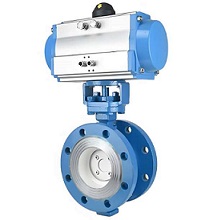
Pneumatic Triple ECC Butterfly Valve

A high-performance butterfly valve designed for critical applications requiring bubble-tight shutoff, zero seat wear, and excellent performance in high-temperature, high-pressure, and abrasive media conditions. The triple eccentric design ensures a cam-like wiping action, preventing contact between the disc and seat during operation, making it the ideal choice for isolating or controlling flow in demanding industrial environments.

View Technical Specs
DIN Resilient Seated NRS Gate Valve

Product Overview

The Pneumatic Triple Eccentric (Triple Offset) Butterfly Valve represents the pinnacle of butterfly valve technology. Its name derives from the three distinct offsets engineered into its design: the shaft is offset from the centerline of the valve body, the shaft is offset from the centerline of the disc, and the cone axis of the seat is offset from the shaft axis. This sophisticated geometry results in a unique cam-like action during operation.

Unlike concentric or double-eccentric designs, the triple eccentric valve's disc only contacts the seat at the very end of the closing stroke and at the very beginning of the opening stroke. This non-contacting operation virtually eliminates wear on the seating surfaces, ensuring a long service life and maintaining tight shutoff capabilities (often bubble-tight to ANSI Class VI) throughout the valve's lifespan.

This valve is typically equipped with a metal-to-metal seat (e.g., Stellite overlay), making it highly resistant to high temperatures (up to 1000°F / 538°C or more), high pressures (up to Class 600), and abrasive or erosive media. When paired with a powerful pneumatic actuator, it provides fast, reliable, and automated control, suitable for both on/off isolation and modulating control applications in some of the most severe industrial services.

Key Features & Benefits

Triple Eccentric Design

Three distinct offsets create a cam-like action, ensuring the disc only touches the seat at the final moments of closing and initial moments of opening, resulting in zero seat wear during operation.

Bubble-Tight Shutoff

Achieves exceptional sealing performance, often meeting or exceeding ANSI/FCI Class VI standards, making it suitable for critical isolation applications where zero leakage is required.

High-Temperature Capability

Typically features a metal-to-metal seat (e.g., Stellite) that can withstand extreme temperatures up to 1000°F (538°C) or higher, far exceeding the limits of resilient-seated valves.

Abrasion & Erosion Resistance

The metal seat and hard-faced disc edges offer superior resistance to wear caused by abrasive particles, slurries, or high-velocity fluids, ensuring durability in harsh services.

High-Pressure Rating

Engineered to handle high-pressure applications, with pressure ratings typically up to Class 600 (PN100), making it suitable for demanding process industries.

Long Service Life

The combination of non-contacting operation and robust materials significantly reduces maintenance requirements and extends the valve's operational lifespan.

Technical Specifications

Basic Parameters

Parameter Specification Range
Nominal Diameter (DN/NPS) DN50 ~ DN2400 (2" ~ 96")
Nominal Pressure (PN/Class) PN16, PN25, PN40, PN64, PN100
Class 150, Class 300, Class 600
Operating Temperature -22°F ~ 1000°F (-30°C ~ 538°C) (Standard Metal Seat)
Up to 1200°F (649°C) with Special Alloys
Applicable Media Steam, Oil, Gas, Process Fluids, Slurries, Abrasive/Erosive Media, High-Temperature Gases/Liquids
Sealing Class ANSI/FCI Class V, VI (Bubble-Tight)
ISO 5208 Class IV, V, VI

Material Specifications

Component Material Options Standards/Features
Valve Body Carbon Steel, Stainless Steel, Alloy Steel ASTM A216 WCB, A351 CF8/CF8M, A217 WC6/WC9
Disc Carbon Steel, Stainless Steel, Alloy Steel ASTM A182 F22, F304/F316, F51 (Duplex), Hard-Faced (Stellite)
Seat Metal (Stellite, Inconel, Hastelloy) Metal-to-Metal Sealing, High Temp & Abrasion Resistant
Shaft Stainless Steel, Alloy Steel AISI 416, 17-4 PH, ASTM A182 F6a
Actuator Pneumatic (Double-Acting or Spring-Return) 5-10 bar (70-145 psi) Air Supply, Positioner (4-20mA) Option for Modulating Control

Standards & Compliance

  • Design Standards: API 609, ISO 10631
  • Face-to-Face Dimensions: API 609, ISO 5752
  • Flange Standards: ASME B16.5, ISO 7005-1, EN 1092-1
  • Testing Standards: API 598, ISO 5208
  • Certifications: CE, ISO 9001, API 609

Working Principle

The Pneumatic Triple Eccentric Butterfly Valve operates based on its unique three-offset design, which dictates the movement of the disc relative to the seat:

  1. Pneumatic Actuation: A pneumatic actuator, controlled by an external signal (e.g., solenoid valve for on/off, positioner for 4-20mA modulating control), rotates the valve shaft.
  2. The Three Offsets:
    • 1st Offset: The shaft is offset from the centerline of the valve body bore.
    • 2nd Offset: The shaft is offset from the centerline of the disc.
    • 3rd Offset: The cone axis of the seat sealing surface is offset from the shaft axis, creating an angle.
  3. Opening Stroke: As the shaft rotates to open the valve, the combined effect of the three offsets causes the disc to first lift away from the seat and then rotate parallel to the flow. This means the disc does not drag across the seat surface during opening.
  4. Closing Stroke: During closure, the disc rotates towards the seat. It is only in the final few degrees of rotation that the angled seat cone and disc profile cause the disc to cam into the seat, creating the metal-to-metal seal.
  5. Result: This non-contacting operation (except for the final sealing moment) eliminates wear on the critical sealing surfaces, ensuring tight shutoff performance is maintained over many cycles and in abrasive conditions.

Application Areas

Power Generation

Ideal for main steam isolation, turbine bypass, and flue gas desulfurization (FGD) systems where high temperatures and abrasive particulate matter are present.

Oil & Gas

Used in upstream wellheads, midstream pipelines, and downstream refineries for isolation and control of crude oil, natural gas, and various process fluids under high pressure and temperature.

Chemical & Petrochemical

Suitable for handling a wide range of aggressive chemicals, solvents, and high-temperature process streams where tight shutoff and resistance to chemical attack are essential.

Pulp & Paper

Effective in black liquor recovery boilers and lime kiln applications, handling high-temperature, alkaline, and abrasive fluids with minimal maintenance.

Water & Wastewater

Used in large-diameter pipelines for critical isolation in water intake, discharge, and sludge handling systems where reliability and tight closure are paramount.

HVAC & Power Plants

Applied in large air handling units (AHUs), boiler house ducting, and district heating/cooling systems for precise flow control and isolation of air and water streams.

Installation & Maintenance

Installation Guidelines

  • Inspect the valve for any shipping damage. Ensure the valve is clean and the disc rotates freely.
  • Mount the valve between the pipeline flanges, ensuring the flow direction matches the arrow marked on the valve body.
  • Align the flange bolt holes accurately. Use appropriate gaskets compatible with the service conditions (temperature, pressure, media).
  • Tighten the flange bolts evenly in a crisscross pattern to the recommended torque to achieve a uniform seal and prevent distortion.
  • Connect the pneumatic actuator to the air supply and control system (solenoid valve, positioner) following the manufacturer's instructions. Ensure correct air pressure (typically 5-10 bar).
  • Perform a low-pressure air test to check for leaks at the flange connections and actuator before putting the valve into full service.

Maintenance Recommendations

  • Regularly check the actuator for air leaks and ensure the supply pressure is within the specified range.
  • Inspect the valve externally for any signs of leakage from the body, flanges, or stem packing.
  • Lubricate the actuator's bearings and the valve stem packing periodically as per the manufacturer's schedule to ensure smooth operation.
  • For metal-seated valves, periodic cycling (opening and closing) is recommended, even in standby service, to prevent the disc from seizing to the seat due to thermal expansion/contraction or corrosion.
  • In case of seat damage or wear (which is rare but possible in highly abrasive services), the entire valve may need to be removed from the line for seat replacement or refurbishment.
  • Always follow the manufacturer's maintenance manual for detailed procedures and safety precautions.

Frequently Asked Questions (FAQ)

Q: What does "Triple Eccentric" mean?

A: It refers to three specific geometric offsets in the valve's design: 1) The shaft is offset from the center of the valve body. 2) The shaft is offset from the center of the disc. 3) The cone-shaped seat's axis is offset from the shaft's axis. This combination creates the valve's unique non-contacting sealing action.

Q: How does a Triple Eccentric Valve differ from a Double Eccentric (Offset Disc) Valve?

A: A double eccentric valve has the first two offsets but lacks the third (angled seat). This means its disc still slides across the seat during operation, leading to seat wear. The triple eccentric valve's third offset eliminates this sliding, resulting in superior seat life and sealing performance, especially for metal seats.

Q: Can a Triple Eccentric Butterfly Valve be used for throttling (modulating control)?

A: While primarily designed for on/off isolation, some triple eccentric valves can be used for moderate throttling when equipped with a high-performance positioner. However, their flow characteristic is typically not as linear as a globe control valve. For highly precise flow control applications, a dedicated control valve is generally recommended.

Q: What is the typical temperature range for a Triple Eccentric Valve?

A: Standard metal-seated triple eccentric valves can handle temperatures from approximately -22°F (-30°C) up to 1000°F (538°C). Special designs with exotic alloys can extend this range even higher for extreme high-temperature applications.

Q: Is a Triple Eccentric Valve suitable for slurry applications?

A: Yes, it is very suitable. Its metal-to-metal seat and non-contacting operation make it highly resistant to wear from abrasive particles found in slurries, providing a much longer service life compared to resilient-seated valves in such applications.

Need Custom Solutions?

Our engineering team can customize Pneumatic Triple ECC Butterfly Valves to meet your specific pressure, temperature, and media requirements. Contact us today for a personalized quote.

Contact Our Technical Team